
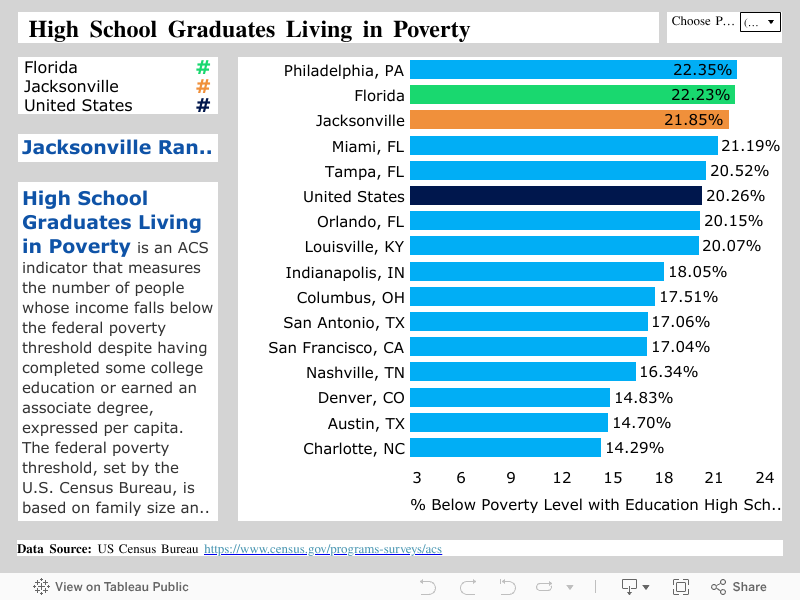


Below Poverty Levels with College or Bachelor’s Degree, as per ACS data, refers to the percentage of individuals aged 25 and older who have a bachelor’s degree (or higher) and whose household income falls below the federal poverty threshold, as determined by the U.S. Census Bureau. The ACS determines poverty status using pre-tax money income and official poverty thresholds that vary by family size and composition.
Low-income adults are disproportionately less likely to have a college degree, and communities where more adults hold degrees see lower poverty rates and improved economic stability. 1
Academic research consistently finds that higher rates of college completion in a city are associated with lower overall poverty, reduced reliance on public assistance, and broader social benefits such as improved health, civic participation, and intergenerational mobility. These effects have been documented in studies analyzing metropolitan-level ACS data, for example, by Glaeser & Saiz in their work on “The Rise of the Skilled City.” 2
